

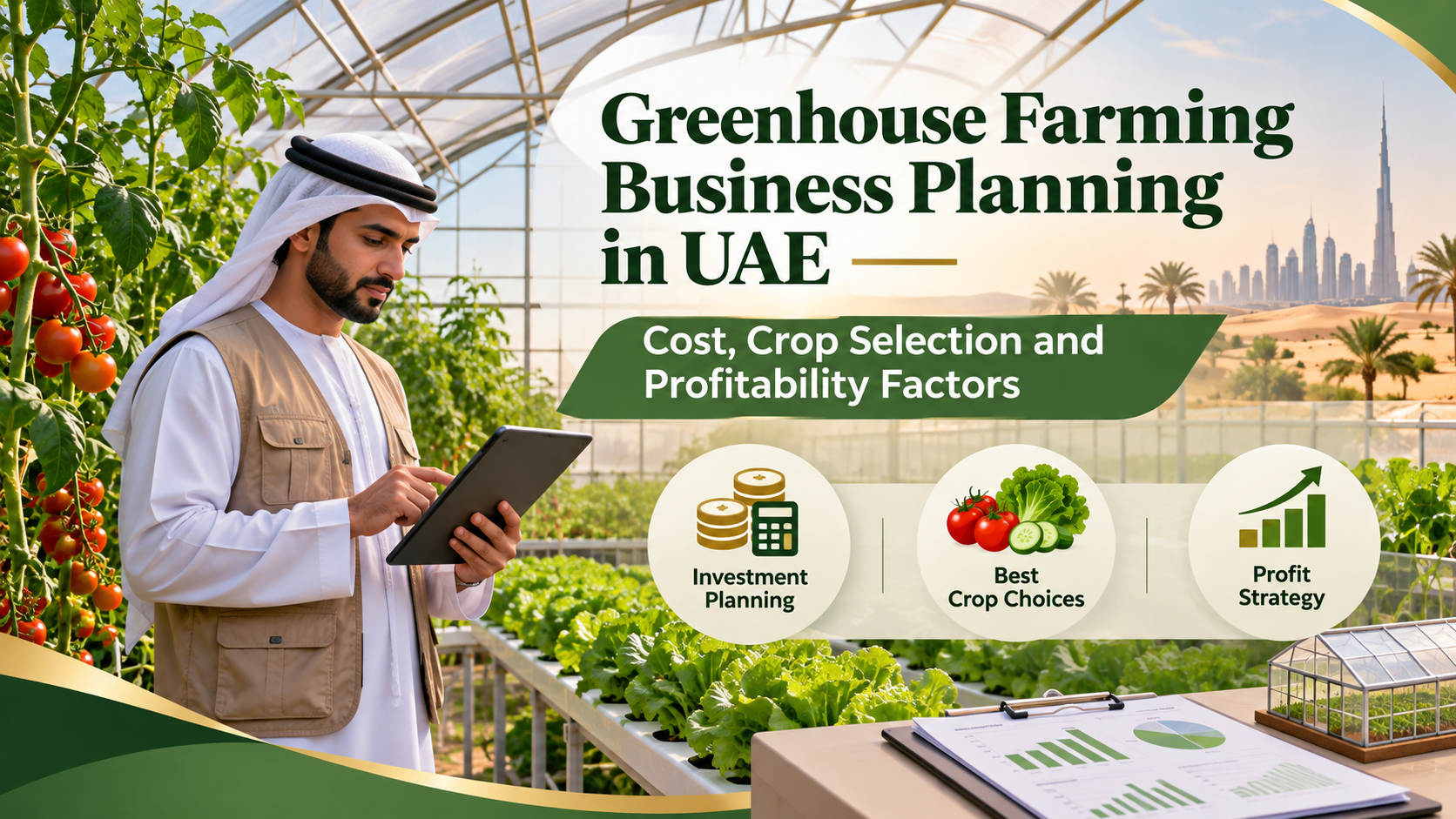
Greenhouse farming is becoming one of the most practical and future-ready agricultural business models in the UAE. With high temperatures, sandy soils, limited rainfall, and increasing demand for fresh local produce, protected cultivation gives farmers, investors, schools, restaurants, and agribusiness owners a smarter way to grow crops with better control and higher consistency.
In places like Umm Al Quwain, Sharjah, Ajman, Dubai, and other UAE regions, open-field farming can be challenging during extreme summer heat, sandstorms, wind exposure, and water scarcity. A well-planned greenhouse helps reduce these risks by creating a controlled growing environment where temperature, irrigation, humidity, light, and crop nutrition can be managed more effectively.
However, greenhouse farming is not just about building a structure and planting crops. A successful greenhouse business requires careful planning, correct crop selection, reliable irrigation, suitable growing media, proper pest management, and a clear understanding of costs and profitability factors.
For farmers, hydroponic growers, students, landscaping professionals, and agriculture entrepreneurs in the UAE, this guide explains the key points to consider before starting a greenhouse farming business.
- Understanding the Main Costs of Greenhouse Farming in UAE
Before investing in greenhouse farming, it is important to understand the major cost areas. The total investment depends on the size of the greenhouse, type of structure, cooling system, crop type, irrigation design, automation level, and whether the project uses soil-based cultivation or hydroponics.
Common greenhouse setup costs include:
- Greenhouse structure and covering material
- Cooling system such as fan-pad cooling, exhaust fans, misting, or shading
- Irrigation system, drip lines, filters, pumps, and tanks
- Fertigation system for fertilizer mixing and nutrient delivery
- Growing beds, pots, grow bags, trays, or hydroponic channels
- Seeds, seedlings, cocopeat, perlite, potting mix, and fertilizers
- Pest control products and monitoring tools
- Labour, electricity, water, maintenance, and crop support materials
In the UAE, heat management is one of the most important cost factors. A simple net house or naturally ventilated greenhouse may be suitable for certain crops and seasons, while high-value year-round production may require a more advanced cooled greenhouse.
The goal is not always to choose the cheapest structure. The best choice is the structure that matches your crop, season, budget, and market plan.
- Choosing the Right Crop for Profitability
Crop selection is one of the most important decisions in greenhouse farming. A beautiful greenhouse will not become profitable if the crop is not suitable for the climate, market demand, or production system.
In the UAE, greenhouse farmers commonly choose crops that have strong demand, good selling prices, and shorter production cycles.
Popular greenhouse crops in UAE include:
- Cucumber
- Tomato and cherry tomato
- Capsicum and sweet pepper
- Lettuce and leafy greens
- Herbs such as basil, mint, coriander, and parsley
- Strawberry under controlled systems
- Microgreens
- Seedlings and nursery plants
- Ornamental plants and indoor plants
Factors to consider when selecting crops:
- Market demand
Choose crops that are regularly purchased by supermarkets, restaurants, hotels, catering companies, farmers’ markets, or local customers. - Growing season
Some crops perform better during the cooler months, while others need stronger climate control to grow through summer. - Water requirement
In the UAE, water-saving crops and efficient irrigation methods can improve long-term profitability. - Crop cycle duration
Fast-growing crops like lettuce, herbs, and microgreens can provide quicker returns, while crops like tomato and capsicum may need longer management. - Technical skill level
Beginners may start with easier crops such as cucumber, leafy greens, herbs, or nursery plants before moving into advanced hydroponic tomato, capsicum, or strawberry production.
A good business plan should focus on crops that can be grown successfully, sold consistently, and managed within the available budget and technical capacity.
- Soil-Based Greenhouse vs Hydroponic Greenhouse
One of the major planning decisions is whether to grow crops in soil, grow bags, pots, or hydroponic systems.
Soil-based or media-based greenhouse farming
This system uses soil, potting mix, cocopeat, perlite, compost, or grow bags. It is suitable for many growers because it is easier to start and more familiar to traditional farmers.
Benefits include:
- Lower starting cost compared to fully automated hydroponics
- Easier learning curve for beginners
- Suitable for vegetables, herbs, ornamentals, and nursery plants
- Flexible crop choices
For better results, growers should use clean, well-draining, low-salinity growing media. In UAE conditions, poor soil and high salinity can reduce crop performance. High-quality potting soils, cocopeat mixes, fertilizers, trays, grow bags, and irrigation items from trusted suppliers like Al Falaj Gardens can help growers create a healthier root zone.
Hydroponics is a soil-free growing method where plants receive nutrients through water-based solutions. It is highly suitable for controlled greenhouse farming in the UAE, especially for leafy greens, herbs, lettuce, strawberry, and some vegetable crops.
Benefits include:
- Efficient water use
- Faster growth under proper management
- Cleaner production system
- Better control over nutrients
- Suitable for vertical and space-saving farming
Hydroponics requires more technical knowledge, proper nutrient management, EC and pH monitoring, and reliable system design. Al Falaj Gardens provides hydroponic systems, irrigation equipment, growing materials, and technical support for growers planning soil-free farming projects.
- Key Profitability Factors in Greenhouse Farming
Profitability in greenhouse farming depends on more than crop yield. A farmer must manage production costs, market timing, crop quality, and system efficiency.
Important profitability factors include:
- Yield per square metre: Higher productivity from the same area improves returns.
- Market price: Prices can change based on season, quality, and supply.
- Crop quality: Uniform, clean, fresh produce attracts better buyers.
- Water and electricity cost: Efficient irrigation and cooling systems help reduce expenses.
- Labour efficiency: Good layout and automation can reduce daily workload.
- Pest and disease control: Early monitoring prevents major crop losses.
- Post-harvest handling: Proper harvesting, grading, packing, and storage protect product value.
- Consistent buyers: Restaurants, hotels, groceries, and direct customers can support stable income.
One of the biggest mistakes in greenhouse business planning is calculating only the construction cost and ignoring running costs. Electricity, water, labour, fertilizers, pest control, seed replacement, maintenance, and packaging must all be included in the financial plan.
- Sustainability and Water-Saving Planning for UAE Conditions
In the UAE, successful greenhouse farming must be designed around sustainability. Water conservation, heat resilience, and efficient production are not optional; they are essential for long-term success.
Practical sustainability tips:
- Use drip irrigation or hydroponic systems to reduce water wastage.
- Install filters to protect irrigation lines from clogging.
- Use shade nets or proper greenhouse covering to reduce heat stress.
- Select heat-tolerant crop varieties whenever possible.
- Use mulch, grow bags, or quality potting media to improve root-zone moisture.
- Monitor pests regularly instead of overusing pesticides.
- Reuse water carefully in hydroponic systems when technically suitable.
- Plan crop timing around cooler months to reduce cooling costs.
Greenhouse farming in the UAE can support local food production, reduce dependence on imported produce, and create opportunities for modern agriculture businesses. But the system must be planned properly from the beginning.
Practical Checklist Before Starting a Greenhouse Farm
Before investing, ask these important questions:
- What crop will I grow and who will buy it?
- What is the expected production per season?
- Will I use soil, grow bags, or hydroponics?
- What cooling system is required for my crop?
- What is my water source and water quality?
- How much electricity will the system need?
- What supplies are required every month?
- Do I have technical support for irrigation, fertigation, and crop care?
- What is my selling price and expected profit margin?
- How will I manage pests, diseases, and crop failures?
A clear answer to these questions will help reduce risk and improve business success.
Conclusion: Smart Planning Creates Profitable Greenhouse Farming
Greenhouse farming in the UAE offers strong opportunities for farmers, investors, schools, restaurants, hydroponic growers, and agriculture entrepreneurs. It allows better control over harsh climate conditions, improves water efficiency, protects crops from wind and pests, and supports year-round production when designed correctly.
The most successful greenhouse projects are not always the biggest or most expensive. They are the ones planned with the right crop, suitable structure, efficient irrigation, quality growing materials, realistic cost calculation, and a strong market strategy.
Whether you are planning a small greenhouse for herbs and vegetables, a hydroponic lettuce unit, a nursery production area, or a commercial crop production system, expert guidance and reliable materials can make a major difference.
For high-quality seeds, potting soils, irrigation equipment, hydroponic systems, green wall solutions, gardening supplies, and greenhouse farming support, visit Al Falaj Gardens Agricultural Materials Trading LLC in Falaj Al Mualla, Umm Al Quwain. Our team is ready to support UAE growers with practical products, trusted advice, and sustainable agriculture solutions.
Visit Al Falaj Gardens Shop or contact our store today to start planning your greenhouse farming project with confidence.