

Introduction
Agriculture in the UAE is developing rapidly, but farming in this region comes with unique challenges. High summer temperatures, sandy soils, limited freshwater resources, salinity, strong winds, and pest infestation can make open-field crop production difficult. At the same time, demand for fresh, safe, and locally produced vegetables, herbs, and fruits is increasing.
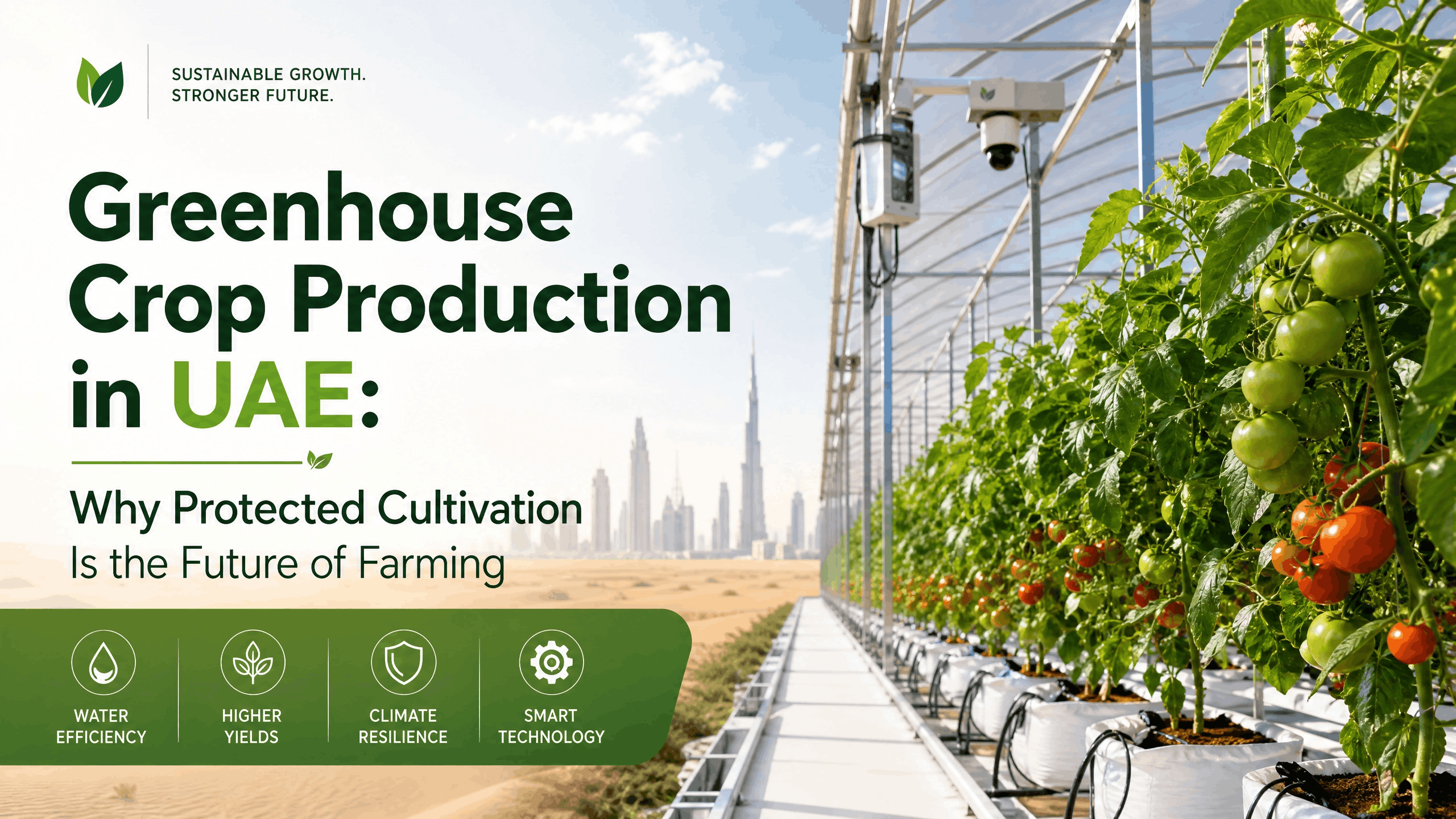
This is where greenhouse crop production, also known as protected cultivation, becomes highly important. A greenhouse allows farmers to grow crops inside a controlled or semi-controlled environment. Instead of depending completely on outdoor weather, growers can manage temperature, humidity, irrigation, fertigation, ventilation, light, and pest control more efficiently.
For the UAE, protected cultivation is not just a modern farming method. It is a practical solution for improving food security, saving water, increasing crop quality, and producing fresh crops throughout more months of the year.
- Why Greenhouses Are Suitable for UAE Conditions
The UAE climate is hot and arid, especially during the long summer season. Many vegetable crops such as tomato, cucumber, capsicum, lettuce, herbs, and strawberry need specific temperature and humidity ranges for healthy growth. In open fields, extreme heat can reduce flowering, fruit setting, plant growth, and final yield.
Greenhouses help reduce the direct impact of harsh weather. With proper design, shade, cooling, ventilation, fogging, and irrigation systems, the internal growing environment can be improved. This allows crops to grow more uniformly and produce better-quality fruits and leaves.
Protected cultivation also helps reduce wind damage, sand accumulation, sunburn, and sudden stress on plants. For commercial farmers, this means more predictable production. For students, teachers, and agriculture professionals, greenhouses provide an excellent practical learning model for modern farming systems.
- Better Water and Nutrient Management
Water is one of the most valuable resources in UAE agriculture. Traditional open-field irrigation can lead to water loss through evaporation, deep percolation, and uneven distribution. In greenhouse farming, water can be supplied directly to the root zone through drip irrigation, hydroponic systems, or automated fertigation.
This improves water-use efficiency and helps plants receive the correct amount of water at the correct time. When combined with sensors, timers, EC meters, pH meters, and nutrient dosing systems, greenhouse growers can manage irrigation more scientifically.
Hydroponic greenhouse systems are especially useful in the UAE because they allow crop production without soil. Nutrient solution is delivered directly to the roots, and the grower can control EC, pH, oxygen, and nutrient balance. Crops such as lettuce, basil, mint, cucumber, tomato, and leafy vegetables can perform very well under properly managed hydroponic systems.
Good nutrient management also reduces fertilizer wastage. Instead of applying fertilizer blindly, growers can adjust feeding according to crop stage, season, water quality, and plant response.
- Higher Yield, Better Quality, and Year-Round Production
One of the biggest advantages of greenhouse crop production is higher productivity per unit area. Since crops are grown under a managed environment, plant spacing, training, pruning, irrigation, nutrition, and pest control can be optimized.
For example, greenhouse cucumbers and tomatoes can be trained vertically, allowing better use of space and improved air circulation. Leafy vegetables and herbs can be grown in NFT systems, vertical systems, or bench systems to increase production in limited areas.
Greenhouses also produce cleaner and more uniform crops. Fruits can have better color, shape, size, and shelf life when temperature, nutrition, and irrigation are properly controlled. This is important for supermarkets, restaurants, hotels, and direct customers who demand consistent quality.
In the UAE market, locally produced fresh vegetables and herbs have a strong advantage because they can reach consumers quickly after harvest. Shorter transport time means better freshness, less damage, and reduced post-harvest loss.
- Pest and Disease Control in Protected Cultivation
Greenhouses do not completely remove pest and disease problems, but they make crop protection more manageable. In open-field farming, pests can enter freely, and disease pressure may increase due to dust, wind, weeds, and uncontrolled moisture. In a greenhouse, growers can use insect nets, double-door entry systems, sticky traps, sanitation, and monitoring to reduce pest entry and spread.
Common greenhouse pests in the UAE may include whiteflies, thrips, aphids, mites, leaf miners, and caterpillars. Diseases such as powdery mildew, root rot, damping-off, and bacterial infections can also occur if humidity, drainage, and hygiene are not managed properly.
Integrated Pest Management, or IPM, is the best approach. This includes regular scouting, removal of infected plants, use of clean seedlings, proper spacing, biological control where suitable, and careful pesticide application only when necessary.
A clean greenhouse is a productive greenhouse. Simple practices such as disinfecting tools, removing crop residues, controlling weeds around the structure, and monitoring water quality can prevent many problems before they become serious.
- Technology and the Future of UAE Farming
The future of farming in the UAE will depend on smart and efficient production systems. Greenhouses are now becoming more advanced with automation, sensors, climate control, data monitoring, fertigation units, hydroponics, vertical farming, and energy-efficient cooling systems.
Smart greenhouses can monitor temperature, humidity, light, soil moisture, EC, pH, and irrigation cycles. This helps farmers make better decisions and reduce guesswork. For agronomists and agricultural engineers, these systems create opportunities for precision farming and professional farm management.
Greenhouse farming also supports education and innovation. Schools, universities, training centers, and agriculture companies can use protected cultivation systems to teach plant science, hydroponics, irrigation, nutrition, pest management, and sustainable farming.
For landscaping professionals and gardening enthusiasts, small greenhouses and shade houses are useful for nursery production, seedling raising, ornamental plants, herbs, and indoor plant preparation. This makes protected cultivation valuable not only for commercial farms but also for garden centers, nurseries, and urban agriculture projects.
Practical Tips for Greenhouse Crop Production in UAE
Choose the right greenhouse structure based on crop type, location, budget, and season. A simple shade house may be enough for nursery plants, while vegetables may need a more advanced greenhouse with cooling and ventilation.
Select crops suitable for protected cultivation, such as cucumber, tomato, capsicum, lettuce, basil, mint, parsley, coriander, strawberry, and microgreens.
Use good-quality irrigation and fertigation systems. Drip irrigation, filtration, pressure regulation, EC and pH monitoring, and proper nutrient dosing are essential for success.
Start with healthy seedlings. Poor seedlings lead to weak plants, uneven growth, and lower yield.
Monitor temperature and humidity daily. In the UAE, heat management is one of the most important parts of greenhouse farming.
Maintain cleanliness. Remove old leaves, weeds, dead plants, and crop waste regularly.
Use insect nets, sticky traps, and regular scouting to detect pests early.
Test water quality before planning hydroponic or greenhouse production, especially for salinity, pH, bicarbonates, and EC.
Train workers properly. Greenhouse farming requires regular observation and timely action.
Keep records of planting date, irrigation, fertilizer use, pest issues, harvest quantity, and crop performance.
Conclusion
Greenhouse crop production is one of the most promising solutions for the future of farming in the UAE. It helps overcome climatic challenges, improves water and fertilizer efficiency, increases yield, enhances crop quality, and supports year-round production.
As the UAE continues to focus on food security, sustainability, and modern agricultural technologies, protected cultivation will play an important role in commercial farming, hydroponics, nurseries, education, landscaping, and urban agriculture.
For farmers, growers, students, engineers, and gardening enthusiasts, learning greenhouse production is no longer optional. It is an essential step toward smarter, more sustainable, and more profitable agriculture.
Call to Action
Al Falaj Gardens Agricultural Materials Trading LLC, UAQ, UAE supports farmers, gardeners, hydroponic growers, nurseries, landscapers, and agriculture professionals with greenhouse materials, hydroponic systems, irrigation solutions, fertilizers, growing media, garden supplies, and technical guidance.
For greenhouse farming, hydroponic setup, irrigation materials, crop production support, and professional agriculture solutions, contact Al Falaj Gardens today and take your farming system to the next level.